
Freedom From Blind Spots: Why Independent Website Audits Matter More Than Ever
Published Jul 2, 2026 by Editorial Team
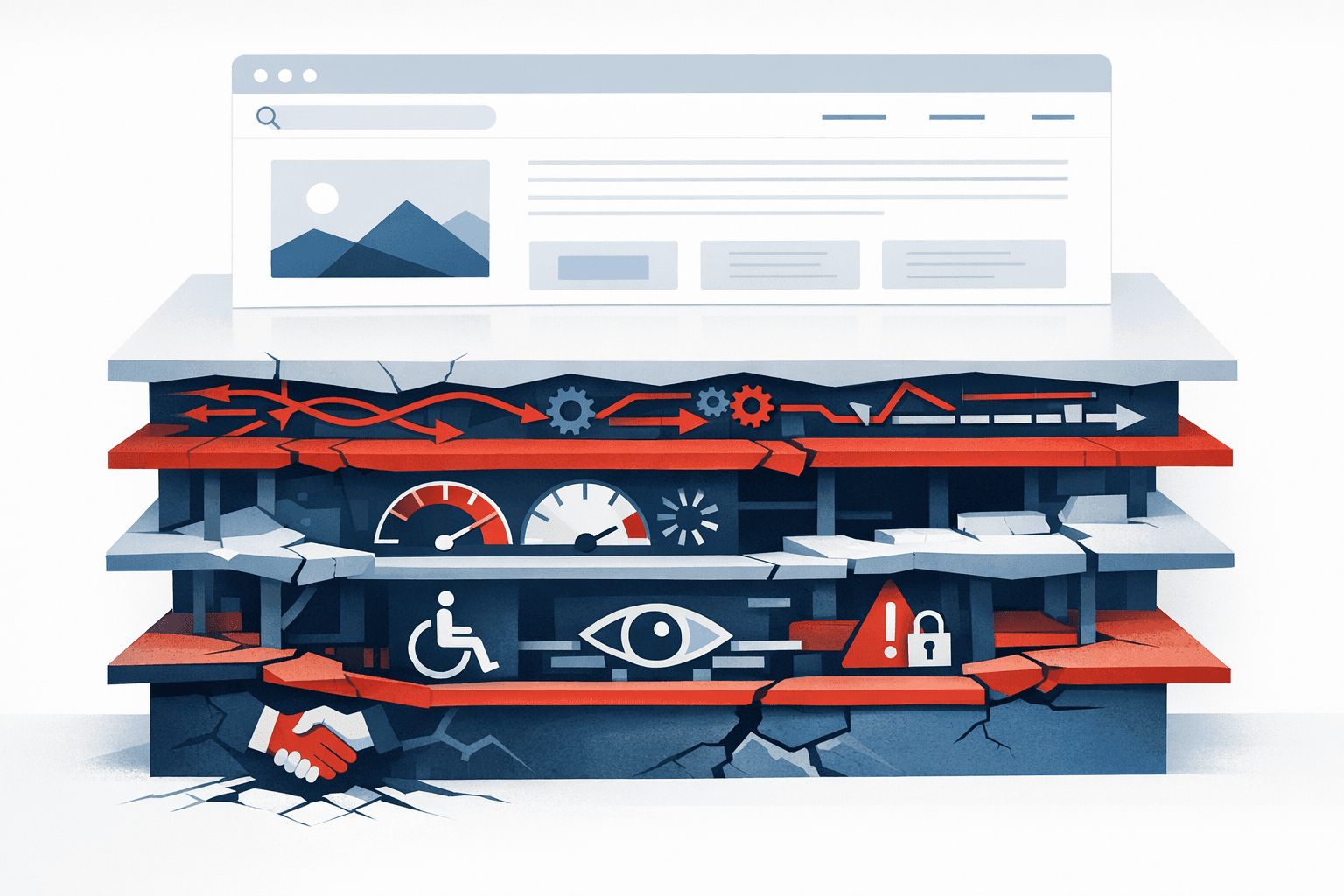
Freedom from blind spots starts with independence from your own assumptions.
That is the uncomfortable truth behind a lot of website underperformance in 2026. A site can look modern, match the brand, pass a quick visual review, and still fail in the places that actually shape discoverability and user trust. The problems are often not dramatic on launch day. They show up later as weaker rankings, softer conversion rates, inaccessible flows, or a site that simply feels worse than the team thinks it does.
Independent website audits matter because they check the site as it behaves in the real world, not just as it looked in design review, staging, or a CMS preview.
A polished website can still fail where it matters
Visual polish is not the same thing as operational health.
A homepage can look excellent while deeper pages have:
- crawl paths that search engines cannot follow cleanly
- templates that render slowly on mobile
- forms that are difficult to use with assistive technology
- broken metadata, weak headings, or missing language declarations
- third-party scripts that quietly degrade performance and trust
None of those issues are reliably caught by taste, intuition, or a stakeholder saying the redesign "looks good." They require inspection.
That is also why independent audits are different from self-scoring. A plugin saying schema is present, a theme saying it is optimized, or a team saying a release passed QA does not prove the site is actually healthy across search, performance, accessibility, and user experience.
Crawlability problems often stay invisible until traffic drops
Search visibility failures are especially easy to miss because they are often invisible to normal browsing. A human can click around a website and think everything is fine while search engines encounter weak internal linking, conflicting directives, or pages that are technically reachable but not easy to discover and interpret.
Google's Search Essentials makes the baseline clear: appearing and performing well in Google Search depends on meeting technical requirements, following spam policies, and getting key best practices right. Those best practices explicitly include making links crawlable and ensuring Google can understand things like structured data and JavaScript.
That should reset how teams think about discoverability. Search problems are not limited to title tags and copy tweaks. They also include the plumbing that determines whether important pages are discoverable, interpretable, and worth surfacing in the first place.
This is one reason independent audits are valuable before a traffic drop, not just after one. They can catch problems like:
- crawlable pages that are buried behind weak internal linking
- noindex, canonical, or robots directives that work against the intended page
- sitemap coverage gaps
- templates that look complete to users but send weaker signals to crawlers
By the time rankings fall, the issue may have been live for weeks.
Performance problems hurt conversions before teams treat them as technical debt
Performance is another blind spot because many teams still talk about it like it is mainly a developer concern or an SEO checkbox.
Google's page experience guidance is more useful than that framing. Google says its ranking systems look at multiple signals aligned with overall page experience, that Core Web Vitals are used by ranking systems, and that site owners should not focus on only one or two aspects in isolation. It also notes that improving page experience is still worth doing beyond direct ranking effects because it makes a site more satisfying to use.
That matters because slow, unstable, or unresponsive pages usually show up as business problems before they get labeled as performance problems. The symptoms are familiar:
- paid traffic that does not convert as well as expected
- product or service pages that feel heavy on mobile
- forms that hesitate at the moment of intent
- layouts that shift just enough to make the site feel unreliable
In other words, visitors do not experience "poor Core Web Vitals." They experience friction.
An independent audit is useful here because it asks harder questions than "did the homepage load?" It checks whether important pages remain fast enough, stable enough, and usable enough under the real conditions that shape conversions.
Accessibility failures are often hiding in plain sight
Accessibility is one of the clearest cases for independent auditing because inaccessible interfaces can still look perfectly fine to internal teams.
The WebAIM Million 2026 report found detected WCAG failures on 95.9% of the top one million home pages, with an average of 56.1 detected errors per page. The most common failures included low-contrast text, missing image alternative text, missing form labels, empty links, and empty buttons.
Those are not edge-case defects. They are mainstream production defects on highly visible websites.
They are also exactly the kind of issues teams miss when they evaluate a site mainly through screenshots, desktop browsing, or internal familiarity with the interface. If your team already knows where everything is, you can easily miss what a first-time visitor, keyboard-only user, or screen-reader user experiences.
The W3C WAI business case for digital accessibility is useful here because it does not treat accessibility as a narrow compliance topic. It frames accessibility as a way to extend market reach, enhance brand, and reduce risk, while also improving the experience for users more broadly.
That is the practical point: accessibility issues are not separate from business performance. They affect who can use the site, how much friction the interface creates, and whether the brand feels competent and trustworthy.
What makes an audit independent
"Independent" does not have to mean an outside consultancy and a massive six-week engagement.
It means the site is being evaluated by a separate verification layer instead of relying on the same system or team that produced the page to also certify that it is healthy.
In practice, that means the audit is not satisfied by:
- a page builder's green checkmarks
- a plugin saying markup exists
- a launch checklist that focused mostly on visual QA
- a staging review that did not reflect real rendered behavior
- a single manual spot check on one or two pages
Independent audits work because they are willing to disagree with the comfortable story a team is telling itself.
What a useful independent website audit should cover
A credible audit should look across the issues that actually compound into blind spots:
- crawlability and indexability
- metadata and structured-data hygiene
- mobile performance and Core Web Vitals
- accessibility basics such as contrast, labels, headings, and language declarations
- trust issues such as HTTPS weaknesses, mixed content, or risky third-party dependencies
- broken links, UX regressions, and visible code-level failures
This is where an all-in-one audit approach becomes practical. Instead of checking each discipline in isolation and hoping someone connects the dots later, a platform like TotalWebTool can help teams review SEO, AI discoverability, performance, accessibility, security, UX, and code quality in one pass, then re-scan after fixes to verify that the problem is actually resolved.
That re-scan step matters more than many teams realize. Blind spots often come from assuming a fix worked because it sounded correct in a ticket or looked correct in a preview. Verification closes that loop.
The real value is earlier truth
The strongest reason independent website audits matter is not that they produce more reports. It is that they produce earlier truth.
They tell you where the website is weaker than it looks:
- before rankings slip
- before campaign traffic gets wasted
- before accessibility barriers harden into reputation damage
- before "minor" technical issues pile into a broader trust problem
A polished website is still only a surface. Independent audits matter because surfaces are where brands present themselves, but underlying systems are where websites succeed or fail.